
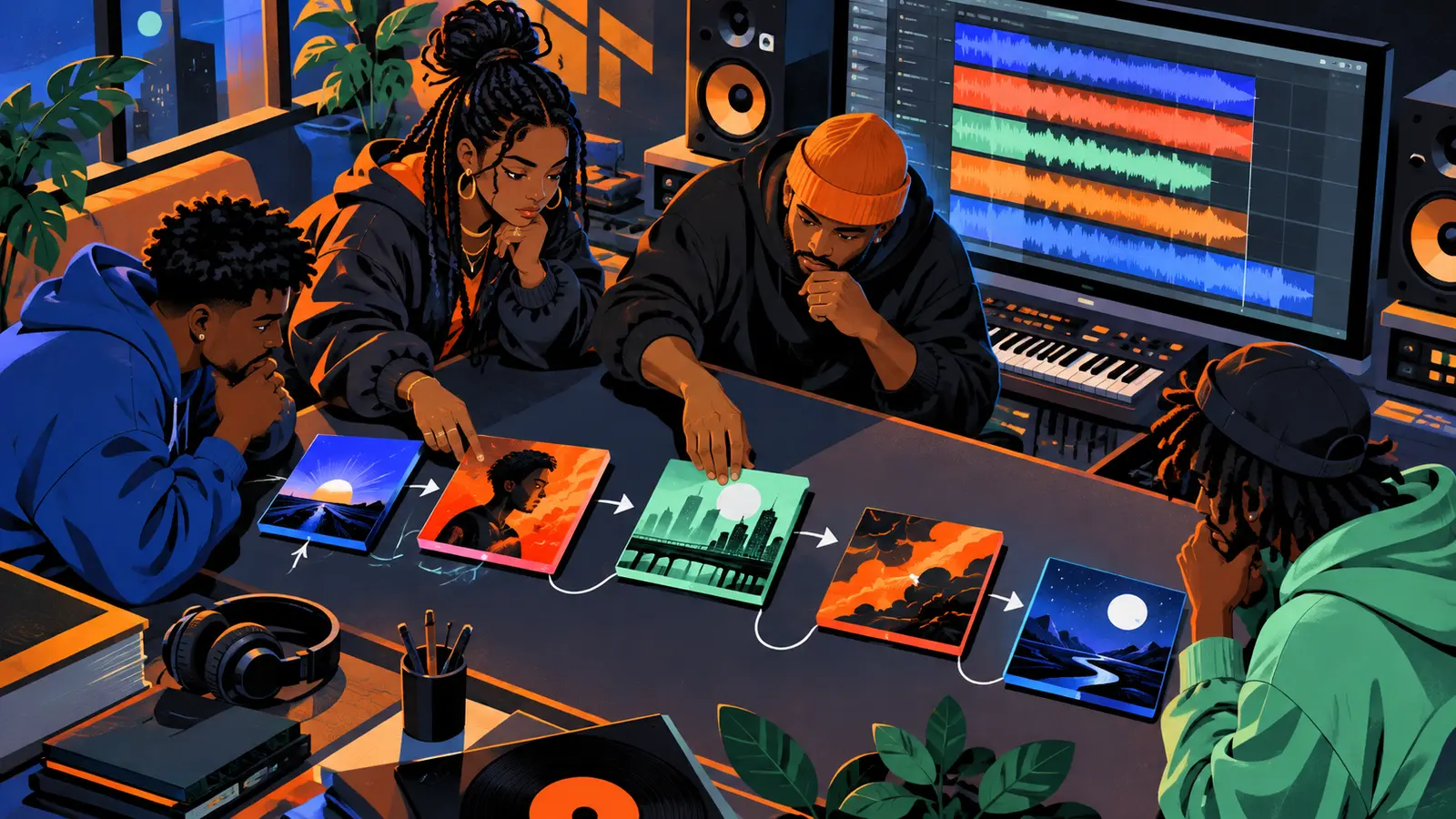
Five tracks are enough to create an arc and short enough that every choice shows. On a focused EP, the opener cannot hide behind a long introduction, the middle cannot carry three versions of the same energy, and the final track has to leave a reason to return. Sequencing is the work of deciding what each song contributes and what changes when one track follows another.
There is no universal five-song formula. This method gives each position a temporary job so you can test the project, not force it into a template.
Define the promise in one sentence
Before ordering tracks, finish this sentence: “Across these five songs, the listener moves from ___ to ___.” The movement can be emotional, narrative, musical, or all three. It might travel from guarded to open, pressure to release, isolation to community, or raw demos to a fully arranged finale.
If the sentence could describe any collection of songs, make it more specific. The promise should help you decide which strong track belongs on another release. A coherent EP is not automatically the five newest masters.
Give every track a job
- Track one — invitation: establish the voice, stakes, and sonic world without explaining everything.
- Track two — proof: deepen the first promise or show the artist can move inside it.
- Track three — turn: introduce contrast, new information, a feature, or a production shift.
- Track four — consequence: bring the project's tension, idea, or energy into sharper focus.
- Track five — exit: resolve, complicate, or deliberately leave open what came before.
A song can do more than one job. The useful question is whether two adjacent songs are doing exactly the same job with the same tempo feel, texture, subject, and vocal approach.
Sequence with your ears before using numbers
Make three possible orders and export each as a continuous listening file or queue. Do not begin with streaming performance, follower reactions, or which title looks most marketable. Listen for the change in the room when one ending meets the next beginning.
Tempo and key can help explain a transition, but they do not decide it. Two tracks with very different speeds may connect through a shared drum texture or lyric. Two tracks with compatible keys may still feel flat because their emotional weight is identical. Treat the numbers as clues after listening, not as commands.
Audit the first and last fifteen seconds
Play only the ending of one song into the opening of the next. Check reverb tails, count-ins, dialogue, long silences, producer tags, abrupt master-level changes, and repeated effects. A transition can be seamless, sharply cut, or intentionally uncomfortable; it should feel chosen.
Do not add an interlude merely to disguise a weak connection. If a spoken moment, field recording, or instrumental bridge belongs to the project, it should add information or atmosphere that the songs need. Confirm permission for every outside voice or recording before release.
Use track three as a pressure test
The center of a five-track sequence is where attention can settle or drift. Try the most obvious single there, then try the strangest or quietest song. Which order makes the first half mean more and creates curiosity about the second?
A feature can create a useful turn, but do not sequence it only because the guest is recognizable. Listen for how the new voice changes perspective, pacing, or color. Credit the contribution accurately and avoid implying a relationship beyond the recorded collaboration.
Check contrast without breaking identity
Map each track across five qualities: density, drum energy, vocal intensity, emotional temperature, and melodic space. You do not need every song to be different. You need enough movement that the listener can feel progress.
The production itself can provide contrast. Practice naming those changes with our guide to hearing hip-hop drum programming. A switch from rigid hats to loose percussion, or from a heavy kick to more open low end, can refresh the sequence without abandoning its palette.
Make the ending earn its place
The final track does not have to be the slowest, longest, or most serious. It does need to change the listener's understanding of what preceded it. Test the closer first: if it feels like an opener, that may reveal a second valid sequence. Test it third: if nothing is lost, the original ending may not be carrying enough weight.
After the last note, wait in silence and summarize the project in three sentences: where it began, what turned, and what remains. The same reflection appears in our guide to hearing a rap album as a complete project.
Run three final passes
- Story pass: follow only lyrics, themes, and point of view.
- Sound pass: follow production, transitions, levels, and repeated textures.
- Listener pass: play the EP without notes and mark only where attention changes.
Then verify titles, versions, contributors, identifiers, and credits with the IHHR metadata checklist. If a clean version is needed, build it carefully with the clean radio edit guide rather than letting last-minute cuts damage the sequence.
When the order is final, explain the project honestly in an artist bio that sounds like you. Discuss general sequencing questions in the reviewed artist forum, explore more craft features in The Signal, and listen live to IHHR for real-world examples of contrast between records.
Press Play above to hear IHHR or visit the official Live365 station page.